I have seen a lot of inspiring people on bicycles
lately.People who are riding for
transport and wearing the style of clothing that suits their destination. Male
and female, all ages, mostly during the day but also some at night.I have even spotted a young guy in a
suit and tie rolling along the west end of St Georges Terrace.It makes me think of the H.G. Wells
quote: Every time I see an adult on a
bicycle, I no longer despair for the future of the human race.
As part of my people watching I have also been playing a
new game. Each day I count the growing
number of people I see who have made the decision not to wear a helmet. I think
public awareness of the issues is increasing, and as a result, more people have
recognised that bicycle helmets have been a negative influence on Australian
society when all things are considered.
I am not a lawyer but I think there is a basic principle
that the law should reflect the opinion of the majority of the people.Have we now reached the tipping point
for the repeal of Australia’s twenty-year-old compulsory helmet laws?There are signs everywhere that we
have.
Even our state and local governments are now presenting a
more relaxed image. This is the
cover of a brochure from the Department of Transport a few years ago (when they
were known as the Department for Planning and Infrastructure). The helmet
message is very strong. You could mistake it for a helmet advertisement if the
child was not looking so grumpy.
Compare it to this recent brochure from the Department of
Transport.
Our local governments also seem to be ready for the law to
be changed.This is the cover of
the Town of Mosman Park’s Cycling and Pedestrian Plan earlier this year.
And here is the clipping from the City of South Perth
website.
I have not stumbled across any examples of helmet-free riding
in City of Vincent publications but you can see that they recognise that people
and bicycles are important.
Of course, advertisers are very aware of the cultural shift towards riding unencumbered.
The master plan for Perth’s new sport stadium was released
this week (7.7 Mb PDF). This new venue, with a seating capacity of 60,000, will become the largest
in Western Australia. Currently Subiaco Oval holds that title and has seating
for around 43,000.
It is debatable whether we actually need to spend $700+
million on another venue for watching
sport. I could make an argument that the money would be better spent on infrastructure
that would make it easier to get around our city on bicycles and as
pedestrians. More doing: less watching.
There are many that would also argue that going to a game is doing and that there is something special
about seeing a sporting contest with a massive crowd.
Once it is built, there will still be 140 larger stadiums
around the world with more capacity. In that context, the proposal seems more modest and perhaps it can be
justified considering Perth has a population of $1.8 million. If watching sport
is not your thing, it will seem like a waste of money. If you are a regular at
live games you will probably be thinking, just build it and hurry up.
One of the most interesting aspects of the stadium plan is a
new pedestrian bridge crossing the river from East Perth to the stadium area. We
have known about this for a while, it was shown on an earlier draft proposal back in March,
but no details were given. When I first saw it I thought, what a great idea, it
would connect the shared bicycle-pedestrian paths on both sides of the river.
People could ride to the games! I started to imagine families travelling together and lots of undercover bicycle
parking around the stadium. After all, it would be a brand new facility and it
could be easily incorporated into the design.
However I was worried that the bridge would be designed for
pedestrians-only and now that I have seen the plan it appears that bicycles are
not being considered.
The document has only two insignificant references to bicycles. There are two drawings that group cycling with recreational pursuits but nothing in relation to transport.
The Principal Shared Path that runs beside the Graham Farmer Freeway is not even shown on their map.
Transport to the stadium will be an important issue. The Burswood peninsula has is a very limited road network and movement is restricted by the barriers of river, rail line and freeway. The Perth Stadium website
says that transport plans will be “based on a target of 70 per cent public
transport use”. There is also a strong focus on pedestrian movements and the
master plan even considers that people may walk for up to thirty minutes to
reach the stadium. Moving 60,000 people in a short period is obviously a
challenge and I think it is admirable that public transport and walking are
being examined, but what about bicycles?
When will the Government of Western Australia’s Department
of Planning start to recognise that bicycles are a transport option? Maybe they
could have a chat with the people in the Department of Transport who produced
the WA Bicycle Network Plan. Both of
the departments are in the same building, these people probably see each other
in the lift, but they are obviously not talking.
Perhaps they could look out the window and see how many
people are getting around on bicycles. We have had a 7% increase this year and
I can see the trend continuing. It is also an Australian Federal Government policy so
there is no reason to not get the message.
Clearly, we need to have a bridge that can handle pedestrians
andbicycles. Maybe it would have two levels or a central division to
avoid conflict.
Now, thinking about parking. If the stadium holds 60,000 and
70% of people are using public transport, then the next biggest group will be the
people who drive to East Perth and walk across the new bridge. Being realistic, maybe there would only be about 5% of people making the journey to the stadium by bicycle.
That means we need bicycle parking for 3,000 please.
Oh, I nearly forgot.
We need a bicycle-pedestrian bridge on the other
side as well. This will connect Maylands to Burswood and East Perth.
Here is how the new Principle Shared Path at Bassendean was looking on Friday. It is not officially open but cyclists have started to use it. More of this please.
At last, the City of Perth has announced that they are
considering a bike share scheme. I think they have been quietly considering it
for a long time. They would have been watching the success stories of bike
share around the world.
Big cities like Paris and London are the most publicised but
there are also very popular systems in smaller cities such as Dublin. In fact,
there are over three hundred that have taken up the idea. You can see them all
on this map.
Why has Perth waited so long? The reason is
obvious to anyone who has seen the poor performance of the Melbourne and
Brisbane bike share schemes. Compulsory helmets are a major problem, but hopefully not
for too much longer. I think the City of Perth has realised that there is a growing
dissatisfaction with the compulsory helmet law in Western Australia and have
joined the push for change. In this article from The WestAustralian
newspaper Perth’s Lord Mayor Lisa Scaffidi acknowledges that the law making it
compulsory to wear a helmet should be relaxed.
If you look around the streets of Perth there are more and
more people who are dressed in normal clothes, riding bicycles for transport
and choosing not to wear a helmet. It is very encouraging.
For Perth’s bike share to succeed we not only have to fix
the helmet problem we will also need to have some more separated infrastructure
and safer ways of getting around town. Lisa Scaffidi's idea of people being able to ride from the new waterfront to Northbridge is
excellent but I doubt that she would want to compete with cars in Barrack Street
in its current form.
Melbourne has had its bike share system since May 2010. I
recently went there for a short holiday with my wife and teenage daughter.
Trying the bike share was high on my list of things-to-do. (Slightly lower for
the other two, something about shopping being more important). We had tried a Barclay’s
“Boris” Bike in London last year and this was a great opportunity to compare an
Australian version.
Our first contact came when the three of us were walking around the docklands area.
We spotted a stand with plenty of bikes and we all agreed that we should continue our wander on a bicycle.
The docklands has lots of open
space without much traffic so it would be a low-stress riding environment.
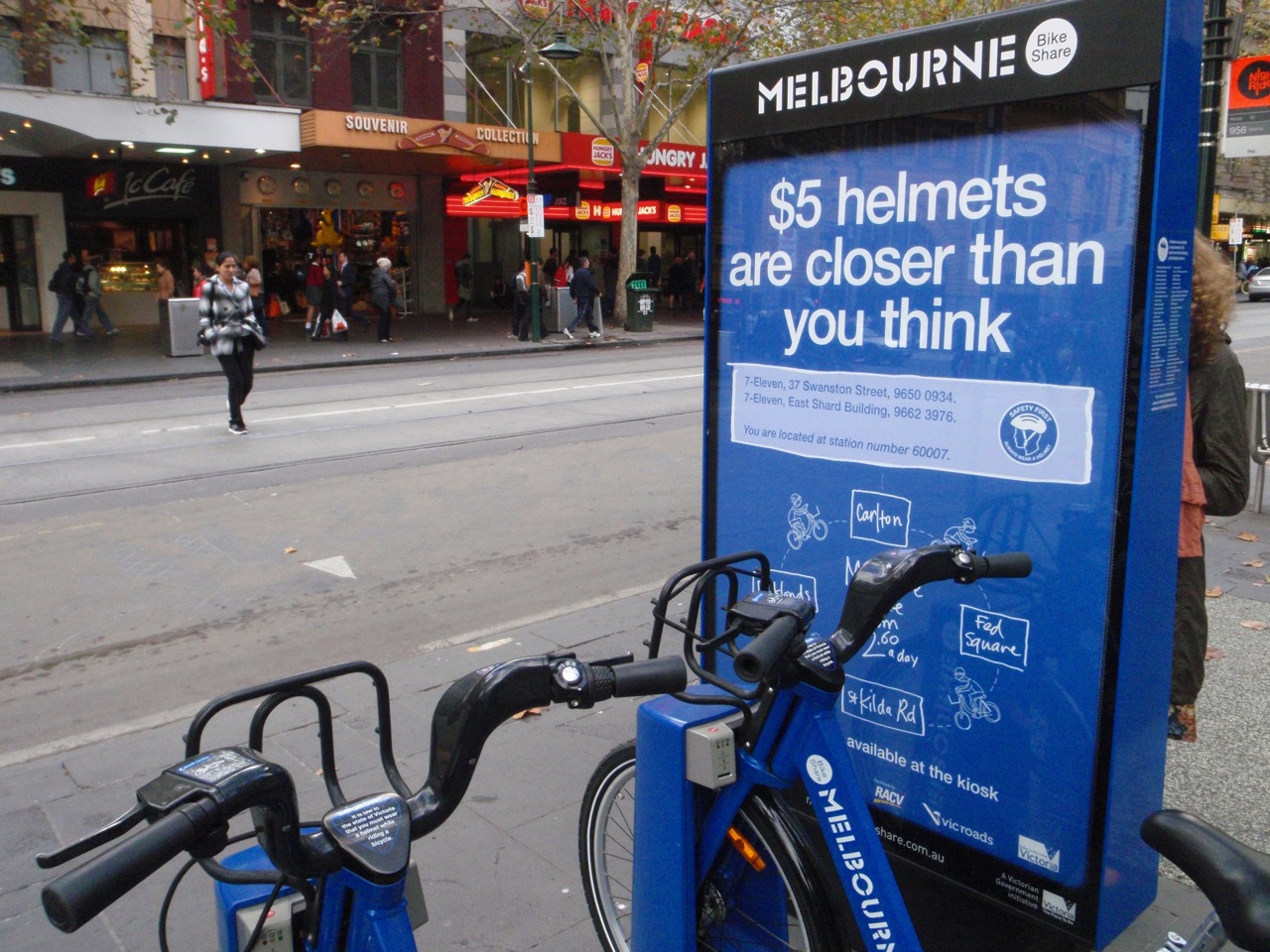
We
read the instructions on the display panel. It said that helmets were available
at a 7-Eleven shop nearby. Unfortunately, we couldn’t see it from where were
standing. We did not want to go searching so the process became too hard and we
decided to keep walking instead.
The inner city of Melbourne has a lot to offer at walking
pace. During the next couple of days we were quite happy getting around on foot
and catching the occasional tram but on my last day in the city I had a couple
of hours to myself and was determined to give Melbourne Bike Share another try.
It was a Saturday afternoon and the stand in Swanston Street
had plenty of bikes. The sign said helmets were available at 7-Eleven: 37
Swanston Street and the East Shard Building.
Not being a local, this was not a
lot of information. I had no idea what the East Shard Building looked like but
it did know I was standing in Swanston Street. Street numbers are usually not
shown on shop fronts in Australia but fortunately I recognised the 7-Eleven
logo about 100 metres away.
I quickly skipped across the street, went into the
shop and asked to buy a helmet. “Sorry, we’re out of stock”. The shop assistant
told me there was another 7-Eleven at Federation Square. OK, that should be
easy to find, even for a tourist. It wasn’t far: about 200 metres down
Swanston, then cross to the other side of Flinders Street. There was another
full rack of bikes available as well.
I found the shop easily but the answer was
the same: “no helmets in stock”. At this point, it had been about ten minutes
and I think most people would have given up. However, I was approaching the task with a bit more
determination than the average person, I was doing research, so I pushed on.
Earlier in the day I had downloaded the phone app called Spotcycle and I used
it to find another bike station. This one was on the other side of the river
at Southbank. It was about a 15 minute walk and the station was also nearly full.
The sign told me that there were three 7-Elevens nearby but there was
no help about which one was closest or in what direction. It would be so much
better if they had a little map with “you are here” and the 7-Elevens indicated.
I walked around a bit, scanning for clues then spotted the logo again.
This
time they had stock. There was a box in the corner with a dozen blue helmets.
The first eleven I picked up were all brand new but the smallest size.
Finally,
buried at the bottom, the last one was a “large”. It wasn’t wrapped and I think
it had been used before but it would have to do. I noticed all the new ones
were wrapped with cable ties and would have been impossible to unwrap without
the help of scissors or pliers. So at least I didn’t have to deal with that
problem. I paid the $5 and went back to the station.
The payment process for the bicycle is fairly easy. I used a
Mastercard and followed the instructions. The cost is $2.60 for the daily
subscription plus the trip fee. If you keep your rides to less than thirty
minutes the trip is free. Thirty to sixty minutes is $2 but after that it gets
expensive. If you go for a four-hour ride it will cost you $57. There is no
limit to the number of times you can hire during a day so the best method is to
make multiple shorter trips and get the bike back into a dock once you arrive
at your destination.
One slightly worrying aspect is that a $50 security deposit
is also taken. Do they really need to do this? They have a record of our credit
card details, I think that should be enough. When I hired the Barclay’s Cycle
in London I am fairly sure that a deposit was not required.
Perhaps they give the reason for the deposit in the eighty
pages of General Terms and Conditions. It is a very small screen, I wonder if
anyone has ever read them. I didn’t, it had taken me forty minutes to get this
far and I wanted to get on a bike before dark.
The next step was to get my receipt and unlock the bike. We
are told that there is a five-digit code that you press onto a keypad. My
receipt had a reference number “54971”. OK that’s easy enough, until I realise
that the key-pad next to the bike only has a choice of 1, 2 and 3. A bit of
head scratching and I went back to the machine and find another ticket sitting
in the tray. Ah…the code is “21313”. I feel slightly stupid but nobody is
watching.
Finally I am on my way. The thing is heavier than I expected
but everything works. It has three speed Nexus gears, lights front and back and
a basic carrier that uses a bungy cord to secure your bag.
Wearing a helmet feels a bit odd but I decide to keep it on.
The Melbourne police seem to be everywhere and for some strange reason they
will think I am a criminal it they see me with a bare head on a bicycle.
I had four days in Melbourne. The whole time was spent
around the inner city and I only saw three other
bike-share bikes being ridden during that time. The other riders were men
aged 20 to 30 and two of them were riding without helmets.
You might also like to watch Mike Rubbo’s excellent film Message to Mebourne from Dublin Bikes. Mike has the blog Situp-cycle. The film has been around for a while and some of you will have seen it already. The
message can be applied to Perth as well.
I have some ideas about how to improve our walking life. Quite a few relate to design elements in the urban environment and the way infrastructure is designed around the car. I will get to them soon.
Dealing with government departments can be a frustrating process. I have no real news to report about the Southport Street crossing that I highlighted in my previous post. I am waiting for the local council to look at the issue and give me their thoughts.
Some good news. We do not always have to deal with government agencies and sometimes it is the small things that we can all do that will make a difference.
A couple of weeks ago I visited the Bethesda Hospital in Claremont. This is a private non-profit hospital that is associated with the Church of Christ. It is very modern and its most recent redevelopment was completed in 2006. My first impressions of the interior are that it is quite impressive. It feels more like a hotel than a hospital. However the exterior is disappointing for a modern design.
They expect to you to arrive by car. This is clearly evident in the layout. The main entry does not have a footpath. It is vehicles-only, “in” and “out”. If you look carefully you may spot the gap in the hedge which is the pedestrian entry located several metres to the north of the logical entry. It appears to be an afterthought in the design because once you go through the gap you are immediately thrust into a car park and there is no footpath to the door. The pedestrian entry has been created by removing one car-parking space and making a hole in the fence.
All this is not a major problem. As pedestrians, we have to deal with this sort of car-orientated design every day of the week. However there was one problem that I noticed and felt compelled to address. There was a footpath crossing the main entry driveway and the hospital’s garden was obscuring the view of any pedestrian walking on the path. It was a blind corner.
The pedestrians and motorists would not be able to see each other until the last second before a collision. The most frequent pedestrians are children from Christ Church Grammar School next door.
I gave the hospital a call and explained the situation to the receptionist. I was not sure they would do anything but a week or so later the offending hibiscus had been removed and the sight lines have been substantially improved.
The Western Australian State Government has recently released a draft of the Western Australian Bicycle Network Plan 2012 - 2021. It has been a long time coming. The last version was done in 1996 and was meant to be reviewed in 2000.
I am pleased that there are signs of progress but I am also underwhelmed with the content. Most of the proposals are obvious. Did it really take sixteen years to produce this? There are a few too many references to doing more "reviews" and things like a "strategic and operational development plan".
Another worrying aspect is that there is no money allocated yet to do the work. The plan shows an intention to increase the spending on the Principal Shared Paths from $0.91 million to $10.91 million per year and the overall spending is planned to be about $16.7 million per year. At first this seems like a lot of money but it represents only 1.39% of the Western Australian budget for roads.
I will be thankful if all of the proposals are implemented but I think we need to have higher expectations. If we are to achieve the goal of doubling the number of people cycling in Australia by 2016 as described in the Australian Government's National Cycling Strategy we need to move faster and have more money and resources directed to bicycle infrastructure.
Here is an idea. The modal share for bicycles is 1.6% (2009 figure) and if our aim is to double this to 3.2% then we should have 3.2% of the road budget allocated to bicycles. This is a small percentage, not much to ask for really.
The current Western Australian state budget for roads is $1.2 billion per annum which would mean $38.4 million per annum for bicycles. With this amount we could actually get things moving.
Another idea. Given that we all know the obvious health benefits associated with cycling, perhaps we could divert a tiny amount from the Western Australian health budget.
Call it preventative medicine. We should not dare to ask for much, we all know that the hospitals are struggling. How about just a quarter of one percent?
The Western Australian health budget this year is $6,217,600,000 that would give bicycles another $15.5 million.