Tuesday, 23 October 2012

Shared Space fails in Claremont


Bay View Terrace is one of the main shopping streets is the upmarket suburb of Claremont.  It has recently had a makeover using the Shared Space design concept.  The result is a failure.  The idea was to create a welcoming space that would become a destination.  A pedestrian friendly town centre that encouraged people to linger.

The design concept looked like this…


This is how is it looks now…


The central part of the street is dominated by vehicles and pedestrians are using the paths close to the shop fronts as they have always done. 

Two of the Town of Claremont’s key principles for the street after completion of the upgrade was that “pedestrians have first priority” but strangely, they also confirmed that they would “maintain on-street parking numbers”.  These are two opposing principles. Pedestrians will not feel that they have priority with that many vehicles moving around them.  There are so many parking spaces in the street I am not sure that it still conforms to the Shared Space concept.  

The Shared Space approach is
to minimise demarcations between vehicle traffic and pedestrians, often by removing features such as kerbs, road surface markings, traffic signs and regulations….First proposed in 1991, the term is now strongly associated to the work of Hans Monderman who suggested that by creating a greater sense of uncertainty and making it unclear who had right of way, drivers reduce their speed, and everyone reduces their level of risk compensation (Wikipedia)

The theory is that road users will negotiate the space on equal terms.  A nice idea. However, the reality is that a motorist encased in a tonne of metal will intimidate most pedestrians.  The Shared Space concept is a romantic ideal that I have not seen applied with complete success. There are examples from The Netherlands you can read about on the blog A View from the Cycle Path and in the UK on Vole O'Speed.

Shared Space or not, the promise was that the Bay View Terrace upgrade was meant to be pedestrian friendly.  Here is what the proposed transport/movement hierarchy looked like in the Bay View Terrace Concept Plan (7.4 MB PDF)


Cars are currently not at the bottom of the hierarchy.  I think the Town of Claremont may have actually increased the number of car parking spaces from 31 to 32.  They have also created a situation which will encourage a high volume of vehicle traffic through the area.  The time limit for the parking bays has been restricted to a maximum of thirty minutes.  This guarantees there will be a high turnover of vehicles. In addition, the parking is free which means that there will be a regular flow of motorists cruising through the street hoping to find a free bay instead of driving directly to the off-street parking stations in the area.  Some will even loop the block in the vain hope of finding a vacant spot next time.  It will create a lot of extra traffic in a street that is meant to be a “high quality, pedestrian orientated, public realm”.

You can see it happening in this photograph below. The row of cars on the left are all cruising through the street, having turned off from Stirling Highway.  It is 2:50pm on a Friday.


Another example of vehicles having priority.  Most people would get very nervous about using this telephone box with vehicles being parked so close behind.
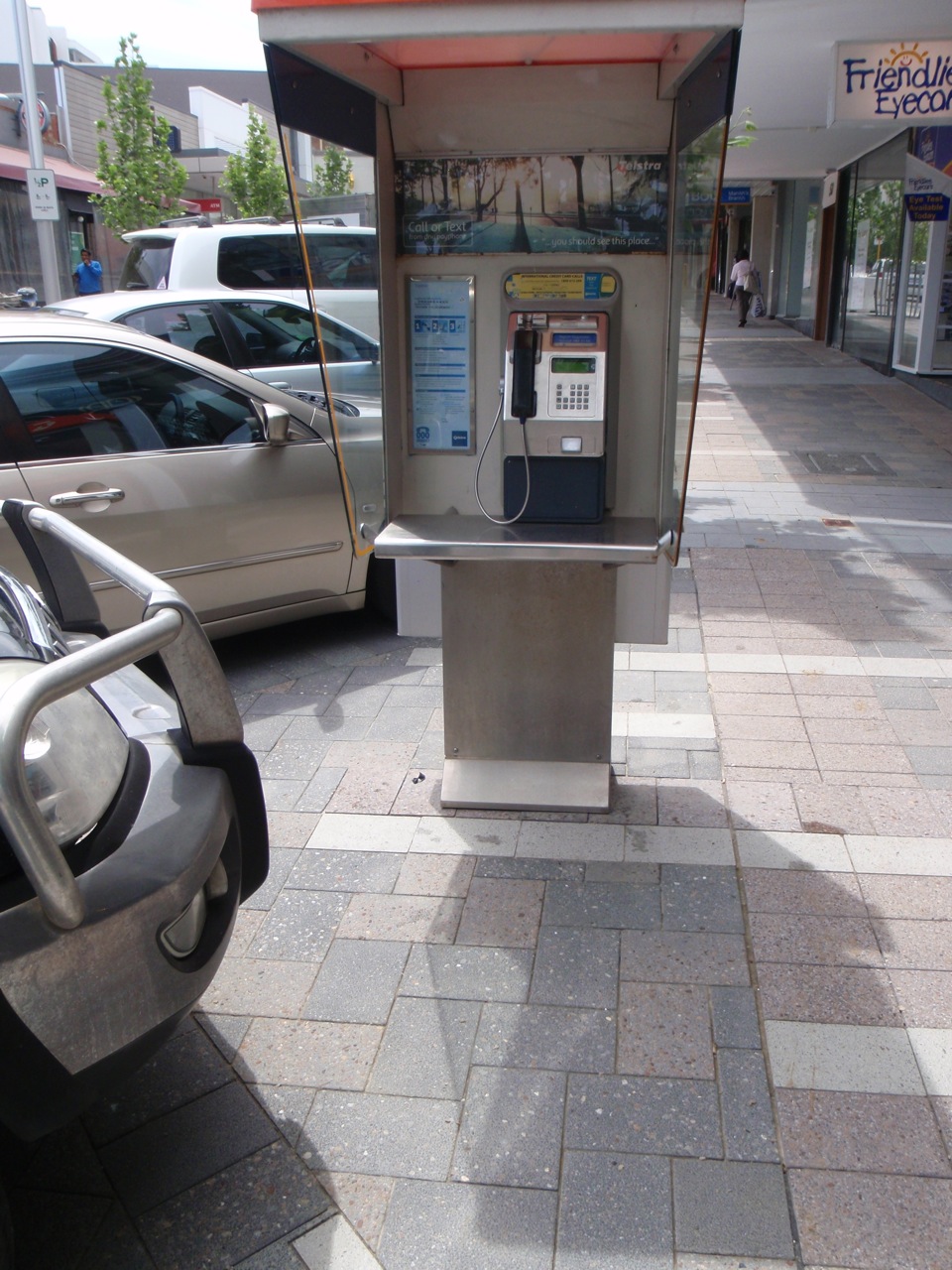


Why did they try to squeeze so much parking into this area?  I suspect that it was the retailers worrying about losing customers.  If they had a little more courage and got rid of the cars they would find that an attractive pedestrian mall would increase their trade.

Bay View Terrace would be much more attractive without the vehicles. 


The landscaping would not need compromises to cope with vehicle movements.  Bollards like this could be removed.


And these aggressive looking tree protectors could be removed sooner.


It is impossible for a pedestrian to relax in what will stay the central vehicle zone of the street.   The street has one-way traffic which could help pedestrians anticipate vehicle movements except that the one-way flow is different at each end of the street.  In the western half of the street vehicles approach from the west.  In the eastern half, vehicles come from the opposite direction!  Combine that with angle parking which means that vehicles could also be reversing at any time and you have an exciting and challenging pedestrian environment.  

I tried walking in front of two vehicles when I was taking these photographs, just to see if the motorists understood the Shared Space concept. It was like a game of "chicken". Most Perth cars have dark tinted windows, combine that with reflections on the windscreen and it can be difficult to make eye contact to "negotiate" the space. The first person did not slow down at all so I bailed out.  For my second attempt, I got directly in front at a much earlier stage so the driver could clearly see me walking. Just before I leapt out of the way the driver stopped. I won. Heart pumping. 

Walking in Bay View Terrace is not recommended for people who are elderly or young children, or adults with prams, or people carrying shopping, or anyone having an interesting conversation that will divert their attention.  All these groups will be much better off going to the Claremont Quarter Shopping Centre around the corner.  Even though there is actually enough space for car parking in the mall, that centre has decided that the shopping experience is much better without vehicles. 


The Town of Claremont has spent $4.25 million on the Bay View Terrace upgrade but it will not be a success as long as they keep the current pro-vehicle policy and design.  It does not help that the Main Roads Department have also made the speed limit 20 km per hour through the street.  I suspect that the Town of Claremont will put some of the blame for the failure of the project on that one issue that is beyond their control.


What is even more worrying is that they might start believing their own promotional spin and think it is all OK.  They just might have to issue everyone with high-vis vests prior to going shopping.


Even some of the most prominent supporters of Shared Space have low expectations for a what makes a street good for pedestrians.  This strange interview with the UK's Ben Hamilton-Baille shows him talking about Shared Space principles that have been applied to the Bristol Temple Meads railway station area.  If you can not stand the waffle, just zoom ahead to the 1:55 mark to watch the pedestrian run across the road to get out of the way of a taxi.


One final note.  I could not find any bicycle parking in the new Bay View Terrace.  There are still a few jobs in progress so hopefully that problem will be fixed in the coming weeks.


Update December 2012 here.


Wednesday, 26 September 2012

Is there a change coming?


I have seen a lot of inspiring people on bicycles lately.  People who are riding for transport and wearing the style of clothing that suits their destination. Male and female, all ages, mostly during the day but also some at night.  I have even spotted a young guy in a suit and tie rolling along the west end of St Georges Terrace.  It makes me think of the H.G. Wells quote: Every time I see an adult on a bicycle, I no longer despair for the future of the human race.

As part of my people watching I have also been playing a new game.  Each day I count the growing number of people I see who have made the decision not to wear a helmet. I think public awareness of the issues is increasing, and as a result, more people have recognised that bicycle helmets have been a negative influence on Australian society when all things are considered.

I am not a lawyer but I think there is a basic principle that the law should reflect the opinion of the majority of the people.  Have we now reached the tipping point for the repeal of Australia’s twenty-year-old compulsory helmet laws?  There are signs everywhere that we have. 

Even our state and local governments are now presenting a more relaxed image.  This is the cover of a brochure from the Department of Transport a few years ago (when they were known as the Department for Planning and Infrastructure). The helmet message is very strong. You could mistake it for a helmet advertisement if the child was not looking so grumpy.


Compare it to this recent brochure from the Department of Transport.


Our local governments also seem to be ready for the law to be changed.  This is the cover of the Town of Mosman Park’s Cycling and Pedestrian Plan earlier this year.


And here is the clipping from the City of South Perth website.


The City of Fremantle is definitely ready for the change: Mayor Brad Petitt's blog.

I have not stumbled across any examples of helmet-free riding in City of Vincent publications but you can see that they recognise that people and bicycles are important.


Of course, advertisers are very aware of the cultural shift towards riding unencumbered. 
A few recent examples.


Saturday, 25 August 2012

Perth Stadium


The master plan for Perth’s new sport stadium was released this week (7.7 Mb PDF). This new venue, with a seating capacity of 60,000, will become the largest in Western Australia. Currently Subiaco Oval holds that title and has seating for around 43,000.

It is debatable whether we actually need to spend $700+ million on another venue for watching sport. I could make an argument that the money would be better spent on infrastructure that would make it easier to get around our city on bicycles and as pedestrians. More doing: less watching.

There are many that would also argue that going to a game is doing and that there is something special about seeing a sporting contest with a massive crowd.

Once it is built, there will still be 140 larger stadiums around the world with more capacity. In that context, the proposal seems more modest and perhaps it can be justified considering Perth has a population of $1.8 million. If watching sport is not your thing, it will seem like a waste of money. If you are a regular at live games you will probably be thinking, just build it and hurry up.


One of the most interesting aspects of the stadium plan is a new pedestrian bridge crossing the river from East Perth to the stadium area. We have known about this for a while, it was shown on an earlier draft proposal back in March, but no details were given. When I first saw it I thought, what a great idea, it would connect the shared bicycle-pedestrian paths on both sides of the river. People could ride to the games! I started to imagine families travelling together and lots of undercover bicycle parking around the stadium. After all, it would be a brand new facility and it could be easily incorporated into the design.

However I was worried that the bridge would be designed for pedestrians-only and now that I have seen the plan it appears that bicycles are not being considered. 


The document has only two insignificant references to bicycles. There are two drawings that group cycling with recreational pursuits but nothing in relation to transport.


The Principal Shared Path that runs beside the Graham Farmer Freeway is not even shown on their map.


Transport to the stadium will be an important issue. The Burswood peninsula has is a very limited road network and movement is restricted by the barriers of river, rail line and freeway. The Perth Stadium website says that transport plans will be “based on a target of 70 per cent public transport use”. There is also a strong focus on pedestrian movements and the master plan even considers that people may walk for up to thirty minutes to reach the stadium. Moving 60,000 people in a short period is obviously a challenge and I think it is admirable that public transport and walking are being examined, but what about bicycles?

When will the Government of Western Australia’s Department of Planning start to recognise that bicycles are a transport option? Maybe they could have a chat with the people in the Department of Transport who produced the WA Bicycle Network Plan. Both of the departments are in the same building, these people probably see each other in the lift, but they are obviously not talking.

Perhaps they could look out the window and see how many people are getting around on bicycles. We have had a 7% increase this year and I can see the trend continuing. It is also an Australian Federal Government policy so there is no reason to not get the message.

Clearly, we need to have a bridge that can handle pedestrians and bicycles. Maybe it would have two levels or a central division to avoid conflict.

Now, thinking about parking. If the stadium holds 60,000 and 70% of people are using public transport, then the next biggest group will be the people who drive to East Perth and walk across the new bridge. Being realistic, maybe there would only be about 5% of people making the journey to the stadium by bicycle. 

That means we need bicycle parking for 3,000 please.

Oh, I nearly forgot. 


We need a bicycle-pedestrian bridge on the other side as well. This will connect Maylands to Burswood and East Perth. 


Monday, 18 June 2012

Build it and they will come

Here is how the new Principle Shared Path at Bassendean was looking on Friday. It is not officially open but cyclists have started to use it. More of this please.


Friday, 15 June 2012

Bike share


At last, the City of Perth has announced that they are considering a bike share scheme. I think they have been quietly considering it for a long time. They would have been watching the success stories of bike share around the world.

Big cities like Paris and London are the most publicised but there are also very popular systems in smaller cities such as Dublin. In fact, there are over three hundred that have taken up the idea. You can see them all on this map.

Why has Perth waited so long? The reason is obvious to anyone who has seen the poor performance of the Melbourne and Brisbane bike share schemes. Compulsory helmets are a major problem, but hopefully not for too much longer. I think the City of Perth has realised that there is a growing dissatisfaction with the compulsory helmet law in Western Australia and have joined the push for change. In this article from The West Australian newspaper Perth’s Lord Mayor Lisa Scaffidi acknowledges that the law making it compulsory to wear a helmet should be relaxed.

If you look around the streets of Perth there are more and more people who are dressed in normal clothes, riding bicycles for transport and choosing not to wear a helmet. It is very encouraging.

For Perth’s bike share to succeed we not only have to fix the helmet problem we will also need to have some more separated infrastructure and safer ways of getting around town. Lisa Scaffidi's idea of people being able to ride from the new waterfront to Northbridge is excellent but I doubt that she would want to compete with cars in Barrack Street in its current form.


Melbourne has had its bike share system since May 2010. I recently went there for a short holiday with my wife and teenage daughter. Trying the bike share was high on my list of things-to-do. (Slightly lower for the other two, something about shopping being more important). We had tried a Barclay’s “Boris” Bike in London last year and this was a great opportunity to compare an Australian version.

Our first contact came when the three of us were walking around the docklands area. 


We spotted a stand with plenty of bikes and we all agreed that we should continue our wander on a bicycle. 


The docklands has lots of open space without much traffic so it would be a low-stress riding environment. 


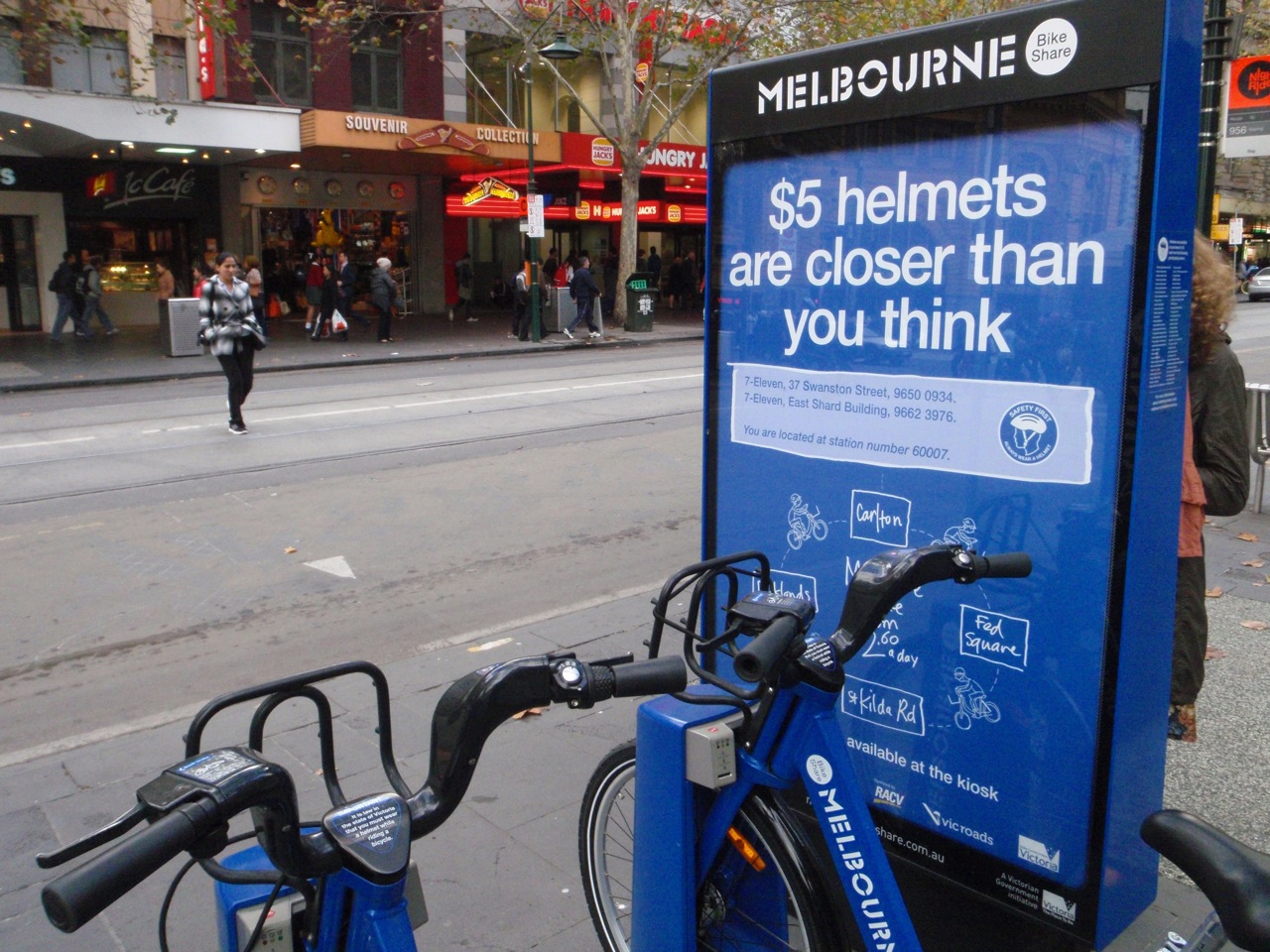
We read the instructions on the display panel. It said that helmets were available at a 7-Eleven shop nearby. Unfortunately, we couldn’t see it from where were standing. We did not want to go searching so the process became too hard and we decided to keep walking instead.

The inner city of Melbourne has a lot to offer at walking pace. During the next couple of days we were quite happy getting around on foot and catching the occasional tram but on my last day in the city I had a couple of hours to myself and was determined to give Melbourne Bike Share another try. 

It was a Saturday afternoon and the stand in Swanston Street had plenty of bikes. The sign said helmets were available at 7-Eleven: 37 Swanston Street and the East Shard Building. 


Not being a local, this was not a lot of information. I had no idea what the East Shard Building looked like but it did know I was standing in Swanston Street. Street numbers are usually not shown on shop fronts in Australia but fortunately I recognised the 7-Eleven logo about 100 metres away. 


I quickly skipped across the street, went into the shop and asked to buy a helmet. “Sorry, we’re out of stock”. The shop assistant told me there was another 7-Eleven at Federation Square. OK, that should be easy to find, even for a tourist. It wasn’t far: about 200 metres down Swanston, then cross to the other side of Flinders Street. There was another full rack of bikes available as well. 


I found the shop easily but the answer was the same: “no helmets in stock”. At this point, it had been about ten minutes and I think most people would have given up. However, I was approaching the task with a bit more determination than the average person, I was doing research, so I pushed on.

Earlier in the day I had downloaded the phone app called Spotcycle and I used it to find another bike station. This one was on the other side of the river at Southbank. It was about a 15 minute walk and the station was also nearly full. 


The sign told me that there were three 7-Elevens nearby but there was no help about which one was closest or in what direction. It would be so much better if they had a little map with “you are here” and the 7-Elevens indicated. I walked around a bit, scanning for clues then spotted the logo again. 


This time they had stock. There was a box in the corner with a dozen blue helmets. 


The first eleven I picked up were all brand new but the smallest size. 


Finally, buried at the bottom, the last one was a “large”. It wasn’t wrapped and I think it had been used before but it would have to do. I noticed all the new ones were wrapped with cable ties and would have been impossible to unwrap without the help of scissors or pliers. So at least I didn’t have to deal with that problem. I paid the $5 and went back to the station.

The payment process for the bicycle is fairly easy. I used a Mastercard and followed the instructions. The cost is $2.60 for the daily subscription plus the trip fee. If you keep your rides to less than thirty minutes the trip is free. Thirty to sixty minutes is $2 but after that it gets expensive. If you go for a four-hour ride it will cost you $57. There is no limit to the number of times you can hire during a day so the best method is to make multiple shorter trips and get the bike back into a dock once you arrive at your destination.

One slightly worrying aspect is that a $50 security deposit is also taken. Do they really need to do this? They have a record of our credit card details, I think that should be enough. When I hired the Barclay’s Cycle in London I am fairly sure that a deposit was not required.


Perhaps they give the reason for the deposit in the eighty pages of General Terms and Conditions. It is a very small screen, I wonder if anyone has ever read them. I didn’t, it had taken me forty minutes to get this far and I wanted to get on a bike before dark.

The next step was to get my receipt and unlock the bike. We are told that there is a five-digit code that you press onto a keypad. My receipt had a reference number “54971”. OK that’s easy enough, until I realise that the key-pad next to the bike only has a choice of 1, 2 and 3. A bit of head scratching and I went back to the machine and find another ticket sitting in the tray. Ah…the code is “21313”. I feel slightly stupid but nobody is watching.


Finally I am on my way. The thing is heavier than I expected but everything works. It has three speed Nexus gears, lights front and back and a basic carrier that uses a bungy cord to secure your bag.


Wearing a helmet feels a bit odd but I decide to keep it on. The Melbourne police seem to be everywhere and for some strange reason they will think I am a criminal it they see me with a bare head on a bicycle.


I had four days in Melbourne. The whole time was spent around the inner city and I only saw three other bike-share bikes being ridden during that time. The other riders were men aged 20 to 30 and two of them were riding without helmets.

You might also like to watch Mike Rubbo’s excellent film Message to Mebourne from Dublin Bikes. Mike has the blog Situp-cycle. The film has been around for a while and some of you will have seen it already. The message can be applied to Perth as well.