There have been a lot of improvements to motor vehicles to reduce the risk of injury to the occupants. Improvements like headrests to prevent whiplash, then seat belts and radial tyres were early additions. Now the list of protective devices seems endless.
Anti-lock braking
Electronic stability control
Collapsible steering columns
Tyre pressure monitors
Seatbelt pretensioner
Lane departure warnings
Active rollover protection
Daytime running lights
Traction control
Front airbags
Side curtain airbags
Head and thorax airbags
Driver's knee airbag
Finally there is an airbag for the people on the outside of vehicles. Cyclists and pedestrians.
"Thursday, November 8 saw a successful demonstration of a special cyclists airbag at the Automotive Campus in Helmond. This airbag is the result of a study commissioned by the Ministry of Infrastructure and the Environment and the Dutch Cyclists' Union to improve the safety of vulnerable road users such as cyclists and pedestrians. Under considerable interest from international audiences, including several car manufacturers, a car equipped with the airbag hit a crash test dummy on a bicycle at 40 miles per hour. The airbag activated successfully so that the head and torso of the dummy were properly protected." (TNO company website)
I got myself a new toy a few weeks ago. A GoPro Hero 2 camera. Yes, that's right, I bought a Hero 2. I didn't know that GoPro were about to release a Hero 3 version which is smaller, lighter, sharper and probably better at everything. For the same price.
Anyway, here are my first impressions using the old model.
Why did I choose the GoPro? It was mostly to do with the shape. The main competition in this market seemed to be the Contour which is basically a long cylinder with the lens on the end. The GoPro is a little rectangular box. I thought the GoPro would be more suitable for what I had in mind.
I wanted something that could be used on a bicycle, but also, Mrs PB is often coming home with stories of crazy motorist antics from her walk to work and we thought it might be useful to record some of these. The GoPro will be able to be mounted to the shoulder strap of her bag fairly easily. She usually does a four kilometre commute into the city and it seems that every week there are dangerous situations that occur during what should be a pleasant walk.
Here is the camera inside its waterproof housing. It is possible to use the camera without the housing but there is no tripod thread in the base and the housing is used as the principle method for securing the camera in various positions. You can see that it is quite small by comparing it to my even more outdated iPhone 3.
Recently I got together with a good friend for a Sunday breakfast. We met near the University of WA in Nedlands and traveled around the river to a little cafe at Garvey Park in Ascot. It was a beautiful day, perfect for riding. Breakfast was good, the conversation even better. On the return journey I gave the GoPro its first test using the head strap that comes with the Outdoor Edition package.
If you live in Perth you will have seen it all before but for others you might be interested in seeing one of our more attractive paths by the river.
This footage was recorded using the 1080HD 25 fps setting. There are no exposure adjustments with the GoPro, and no viewfinder with the standard camera. You just point it in the general direction of what you want to record, switch it on, and that's it. You can adjust the field of view electronically. This is done by a menu option but I decided to stay with the widest setting for this first test.
I think the images are quite good for such a tiny package. The main problem seems to come from a softness around the over exposed highlight areas. The files are recorded in MP4 format. For this film I imported the file into Apple's iMovie software to do some basic editing but the files can also be viewed using Quicktime (or similar software) directly from your desktop.
I think I will have a lot of fun with it. There is a wide range of mounting gadgets and being waterproof it can be used in a lot of interesting situations. For those people considering using one to record vehicle number plates there is a good demonstration of this at the end of the film.
Donna from North Dakota, USA could easily get a job with the Western Australian Main Roads Department. Her concern for the safety of motorists matches the logic that the department uses for pedestrian crossings in Perth. They are dangerous places, collisions happen at them. The best solution is to remove them or put them in places where they are much less trouble for motorists.
Bay View Terrace is one of the main shopping streets is the
upmarket suburb of Claremont.It
has recently had a makeover using the Shared Space design concept.The result is a failure.The idea was to create a welcoming space
that would become a destination.A
pedestrian friendly town centre that encouraged people to linger.
The design concept looked like this…
This is how is it looks now…
The central part of the street is dominated by vehicles and
pedestrians are using the paths close to the shop fronts as they have always
done.
Two of the Town of Claremont’s key principles for the street
after completion of the upgrade was that “pedestrians have first priority” but strangely, they also confirmed that they would “maintain on-street parking numbers”.These are two opposing principles. Pedestrians
will not feel that they have priority with that many vehicles moving around
them. There are so many parking spaces in the street I am not sure that it still conforms to the Shared Space concept.
The Shared Space approach is
to minimise demarcations between vehicle traffic and pedestrians, often by removing features such as kerbs, road surface markings, traffic signs and regulations….First proposed in 1991, the term is now strongly associated to the work of Hans Monderman who suggested that by creating a greater sense of uncertainty and making it unclear who had right of way, drivers reduce their speed, and everyone reduces their level of risk compensation (Wikipedia)
The theory is that road users will negotiate the space on equal terms. A nice idea. However, the reality is that a motorist encased in a tonne of metal will intimidate most pedestrians. The Shared Space concept is a romantic ideal that I have not seen applied with complete success. There are examples from The Netherlands you can read about on the blog A View from the Cycle Path and in the UK on Vole O'Speed.
Shared Space or not, the promise was that the Bay View Terrace upgrade was meant to be pedestrian friendly. Here is what the proposed transport/movement hierarchy looked like in the Bay View Terrace Concept Plan (7.4 MB PDF).
Cars are currently not at the bottom of the hierarchy. I think the Town of Claremont may have actually increased the number of car parking spaces from 31 to 32. They have also created a situation which will encourage a high volume
of vehicle traffic through the area.The time limit for the parking bays has been restricted to a maximum of
thirty minutes.This guarantees there will be a high turnover of vehicles. In addition, the parking is free which means that there will be a regular
flow of motorists cruising through the street hoping to find a free
bay instead of driving directly to the off-street parking stations in the
area.Some will even loop the
block in the vain hope of finding a vacant spot next time.It will create a lot of extra traffic in a
street that is meant to be a “high quality, pedestrian orientated, public realm”.
You can see it happening in this photograph below. The row of cars on the left are all cruising through the street, having turned off from Stirling Highway. It is 2:50pm on a Friday.
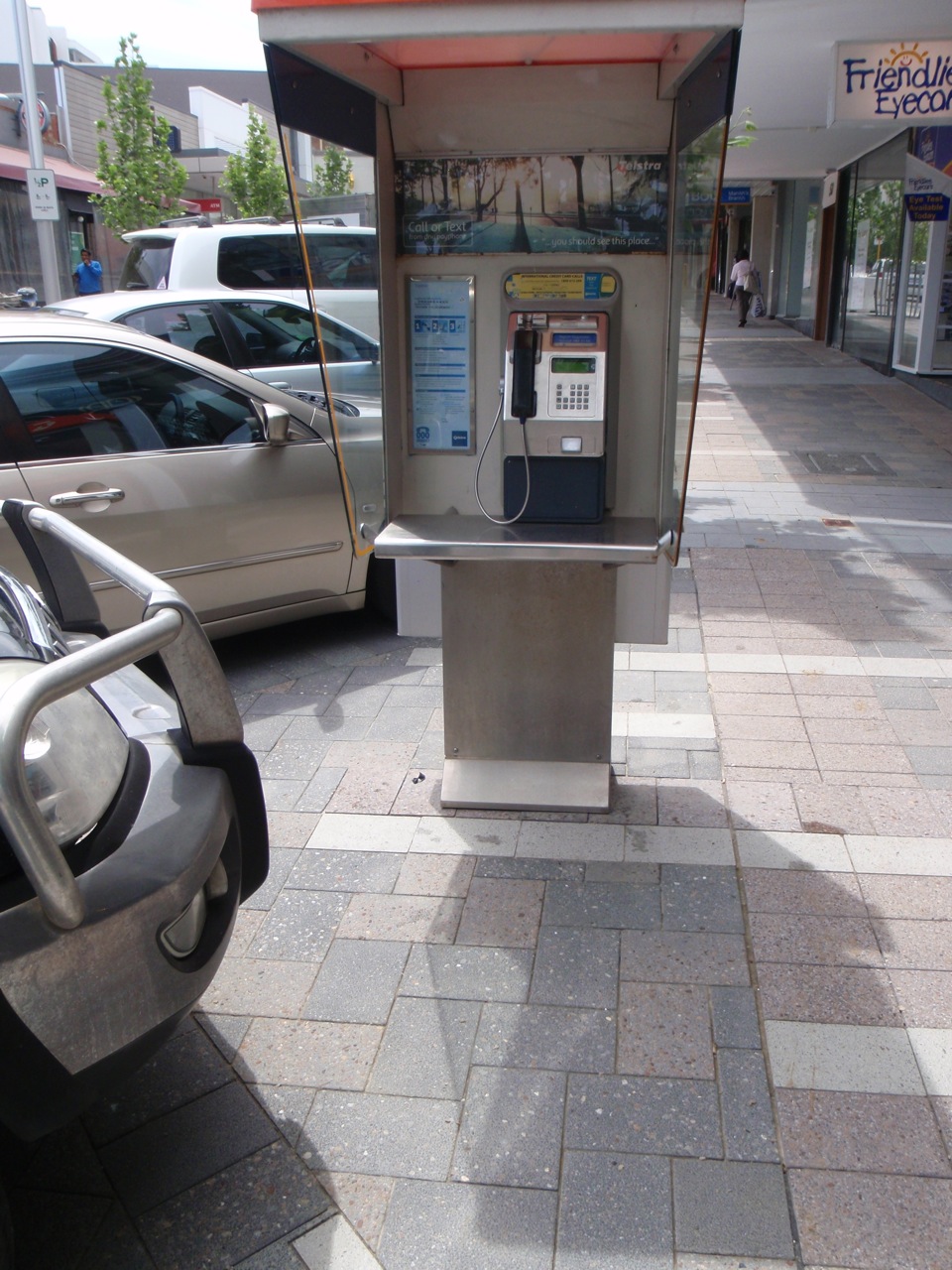
Another example of vehicles having priority. Most people would get very nervous about using this telephone box with vehicles being parked so close behind.
Why did they try to squeeze so much parking into this area? I suspect that it was the retailers worrying about losing customers. If they had a little more courage and got rid of the cars they would find that an attractive pedestrian mall would increase their trade.
Bay View Terrace would be much more attractive without the vehicles.
The landscaping would not need compromises to cope with vehicle movements. Bollards like this could be removed.
And these aggressive looking tree protectors could be removed sooner.
It is impossible for a pedestrian to relax in what will stay the central vehicle zone of the street. The street has one-way traffic which could help pedestrians anticipate vehicle movements except that the one-way flow is different at each end of the street. In the western half of the street vehicles approach from the west. In the eastern half, vehicles come from the opposite direction! Combine that with angle parking which means that vehicles could also be reversing at any time and you have an exciting and challenging pedestrian environment.
I tried walking in front of two vehicles when I was taking these photographs, just to see if the motorists understood the Shared Space concept. It was like a game of "chicken". Most Perth cars have dark tinted windows, combine that with reflections on the windscreen and it can be difficult to make eye contact to "negotiate" the space. The first person did not slow down at all so I bailed out. For my second attempt, I got directly in front at a much earlier stage so the driver could clearly see me walking. Just before I leapt out of the way the driver stopped. I won. Heart pumping.
Walking in Bay View Terrace is not recommended for people who are elderly or young children, or adults with prams, or people carrying shopping, or anyone having an interesting conversation that will divert their attention. All these groups will be much better off going to the Claremont Quarter Shopping Centre around the corner. Even though there is actually enough space for car parking in the mall, that centre has decided that the shopping experience is much better without vehicles.
The Town of Claremont has spent $4.25 million on the Bay View Terrace upgrade but it will not be a success as long as they keep the current pro-vehicle policy and design. It does not help that the Main Roads Department have also made the speed limit 20 km per hour through the street. I suspect that the Town of Claremont will put some of the blame for the failure of the project on that one issue that is beyond their control.
What is even more worrying is that they might start believing their own promotional spin and think it is all OK. They just might have to issue everyone with high-vis vests prior to going shopping.
Even some of the most prominent supporters of Shared Space have low expectations for a what makes a street good for pedestrians. This strange interview with the UK's Ben Hamilton-Baille shows him talking about Shared Space principles that have been applied to the Bristol Temple Meads railway station area. If you can not stand the waffle, just zoom ahead to the 1:55 mark to watch the pedestrian run across the road to get out of the way of a taxi.
One final note. I could not find any bicycle parking in the new Bay View Terrace. There are still a few jobs in progress so hopefully that problem will be fixed in the coming weeks.
I have seen a lot of inspiring people on bicycles
lately.People who are riding for
transport and wearing the style of clothing that suits their destination. Male
and female, all ages, mostly during the day but also some at night.I have even spotted a young guy in a
suit and tie rolling along the west end of St Georges Terrace.It makes me think of the H.G. Wells
quote: Every time I see an adult on a
bicycle, I no longer despair for the future of the human race.
As part of my people watching I have also been playing a
new game. Each day I count the growing
number of people I see who have made the decision not to wear a helmet. I think
public awareness of the issues is increasing, and as a result, more people have
recognised that bicycle helmets have been a negative influence on Australian
society when all things are considered.
I am not a lawyer but I think there is a basic principle
that the law should reflect the opinion of the majority of the people.Have we now reached the tipping point
for the repeal of Australia’s twenty-year-old compulsory helmet laws?There are signs everywhere that we
have.
Even our state and local governments are now presenting a
more relaxed image. This is the
cover of a brochure from the Department of Transport a few years ago (when they
were known as the Department for Planning and Infrastructure). The helmet
message is very strong. You could mistake it for a helmet advertisement if the
child was not looking so grumpy.
Compare it to this recent brochure from the Department of
Transport.
Our local governments also seem to be ready for the law to
be changed.This is the cover of
the Town of Mosman Park’s Cycling and Pedestrian Plan earlier this year.
And here is the clipping from the City of South Perth
website.
I have not stumbled across any examples of helmet-free riding
in City of Vincent publications but you can see that they recognise that people
and bicycles are important.
Of course, advertisers are very aware of the cultural shift towards riding unencumbered.
The master plan for Perth’s new sport stadium was released
this week (7.7 Mb PDF). This new venue, with a seating capacity of 60,000, will become the largest
in Western Australia. Currently Subiaco Oval holds that title and has seating
for around 43,000.
It is debatable whether we actually need to spend $700+
million on another venue for watching
sport. I could make an argument that the money would be better spent on infrastructure
that would make it easier to get around our city on bicycles and as
pedestrians. More doing: less watching.
There are many that would also argue that going to a game is doing and that there is something special
about seeing a sporting contest with a massive crowd.
Once it is built, there will still be 140 larger stadiums
around the world with more capacity. In that context, the proposal seems more modest and perhaps it can be
justified considering Perth has a population of $1.8 million. If watching sport
is not your thing, it will seem like a waste of money. If you are a regular at
live games you will probably be thinking, just build it and hurry up.
One of the most interesting aspects of the stadium plan is a
new pedestrian bridge crossing the river from East Perth to the stadium area. We
have known about this for a while, it was shown on an earlier draft proposal back in March,
but no details were given. When I first saw it I thought, what a great idea, it
would connect the shared bicycle-pedestrian paths on both sides of the river.
People could ride to the games! I started to imagine families travelling together and lots of undercover bicycle
parking around the stadium. After all, it would be a brand new facility and it
could be easily incorporated into the design.
However I was worried that the bridge would be designed for
pedestrians-only and now that I have seen the plan it appears that bicycles are
not being considered.
The document has only two insignificant references to bicycles. There are two drawings that group cycling with recreational pursuits but nothing in relation to transport.
The Principal Shared Path that runs beside the Graham Farmer Freeway is not even shown on their map.
Transport to the stadium will be an important issue. The Burswood peninsula has is a very limited road network and movement is restricted by the barriers of river, rail line and freeway. The Perth Stadium website
says that transport plans will be “based on a target of 70 per cent public
transport use”. There is also a strong focus on pedestrian movements and the
master plan even considers that people may walk for up to thirty minutes to
reach the stadium. Moving 60,000 people in a short period is obviously a
challenge and I think it is admirable that public transport and walking are
being examined, but what about bicycles?
When will the Government of Western Australia’s Department
of Planning start to recognise that bicycles are a transport option? Maybe they
could have a chat with the people in the Department of Transport who produced
the WA Bicycle Network Plan. Both of
the departments are in the same building, these people probably see each other
in the lift, but they are obviously not talking.
Perhaps they could look out the window and see how many
people are getting around on bicycles. We have had a 7% increase this year and
I can see the trend continuing. It is also an Australian Federal Government policy so
there is no reason to not get the message.
Clearly, we need to have a bridge that can handle pedestrians
andbicycles. Maybe it would have two levels or a central division to
avoid conflict.
Now, thinking about parking. If the stadium holds 60,000 and
70% of people are using public transport, then the next biggest group will be the
people who drive to East Perth and walk across the new bridge. Being realistic, maybe there would only be about 5% of people making the journey to the stadium by bicycle.
That means we need bicycle parking for 3,000 please.
Oh, I nearly forgot.
We need a bicycle-pedestrian bridge on the other
side as well. This will connect Maylands to Burswood and East Perth.
Here is how the new Principle Shared Path at Bassendean was looking on Friday. It is not officially open but cyclists have started to use it. More of this please.