Thursday, 8 May 2014

Snorfiets

Snorfiets is the Dutch name for a light moped or scooter. Whenever I see that name I think "snorting bike". After my two-week stay in the Netherlands, my conclusion is that snorfiets are at the top of the transport hierarchy. If you ride a scooter, it seems you can do whatever you want, and go wherever you like. They are fast, can travel on the bicycle paths or the road and rules don't apply.


To an outsider it is very strange that the benefits of the excellent bicycle infrastructure are allowed to be eroded by permitting scooters, travelling at up to 60 km/h, to mix with slow moving bicycles.

The rules allowing scooters on the bicycle paths go back to the 1970s when the under-50cc mopeds or scooters lacked power compared to today's machines. They were not really suitable to ride on the road with fast moving traffic and it was seen as a reasonable concession to allow them on the bicycle paths to assist people who were unable to ride a bicycle. 

This is how they looked in the 1970s. A small motorbike with bicycle style pedals, hence the name mo-ped.


This is how they look now. The pedals are gone and they often share the same chassis and components as the 125cc versions.


Unfortunately, the laws have not kept pace with the technical developments and design evolution. It appears that a lot of rev-heads are taking advantage of the current situation.

Officially there are supposed to be two types of scooters with different speed restrictions: 'light' scooters with blue licence plates restricted to a maximum speed of 25 km/h, and 'heavy' scooters with yellow licence plates restricted to a maximum speed of 45 km/h. The scooters are meant to have speed limiters fitted but it is obvious many people disable these.

The cream coloured scooter below has a yellow license plate and the other has blue. They both look the same to me.


The two types are also meant to be restricted to different grades of bicycle path, but in my few days of riding I could not find any difference. I was 'buzzed' at high speed by both yellow and blue-plated scooters in a wide range of locations, sometimes close enough to brush my sleeve.

You can read a more detailed explanation of the rules in this post on the Bicycle Dutch blog.

During the Hembrow Study Tour I stopped to take a photograph of this group using the bicycle path beside a quiet country road near a small village. The road can be seen in the foreground and it had almost no traffic. 


Within a few seconds this person on a yellow-plated scooter buzzed past them using the bicycle path and not the road. I am not sure if this is legal but to me it is wrong.


This next example, below, shows my daughter on a hire bike in Amsterdam. She's facing a scooter coming towards her at about 40 km/h, and she's looking for an escape route. Although it was not close to hitting her, as an inexperienced rider, this situation is intimidating and unpleasant. This can't be good for tourism.


Not all scooter riders are aggressive, some ride in a reasonable manner but almost all of them are noisy. Most of the scooters have two-stroke motors and are louder than modern cars. In Amsterdam the scooters were often the dominate sound in an otherwise quiet city. 

And then there is the smell to consider. These anti-scooter stickers at some the traffic lights provide a solution.


With the current range and availability of electric bicycles I find it surprising the Dutch government allow the situation to continue. 

Don't take this the wrong way, the Netherlands bicycle infrastructure, even with the scooter problem is much better than our current situation in Australia. 


Tuesday, 22 April 2014

Assen: First impressions

Late this afternoon I arrived in Assen in the Netherlands. Tomorrow I start on a Hembrow Cycling Study Tour covering the towns of Assen and Groningen which are widely regarded as having some of the best bicycle infrastructure in the world. I have been looking forward to experiencing this bicycle utopia for months and now I am finally here.


Having just spent a couple of weeks in London, then two days in Brussels, Assen seems quiet. It is the end of the Easter holiday weekend, but it is... very quiet. And almost no motor vehicles driving around.


Assen is perfect. There are couples riding along holding hands.


Children riding on the road, yet feeling safe enough to read an iPad at the same time.


I caught glimpses of older people. Riding alone.


And with friends.


It is so perfect, it is like being on the set of the movie The Truman Show.


Curiously, at the train station there were hundreds of bicycles, but hardly any people.


Then I noticed a lot of them had not been ridden in a very long time.


This house seemed to be empty. I started to imagine it was made with icing sugar.


And this house was made with chocolate.


And these with ginger bread.


Returning to my hotel, I came to this idyllic scene in one of the town parks. There were deer grazing peacefully. And a lake - with a fountain!

At this I point decided it was not real. David Hembrow must be hiding behind a bush nearby whispering into a two-way-radio: "Rider approaching...3..2..1...cue the sun!".


Wednesday, 16 April 2014

Oxford Street heros

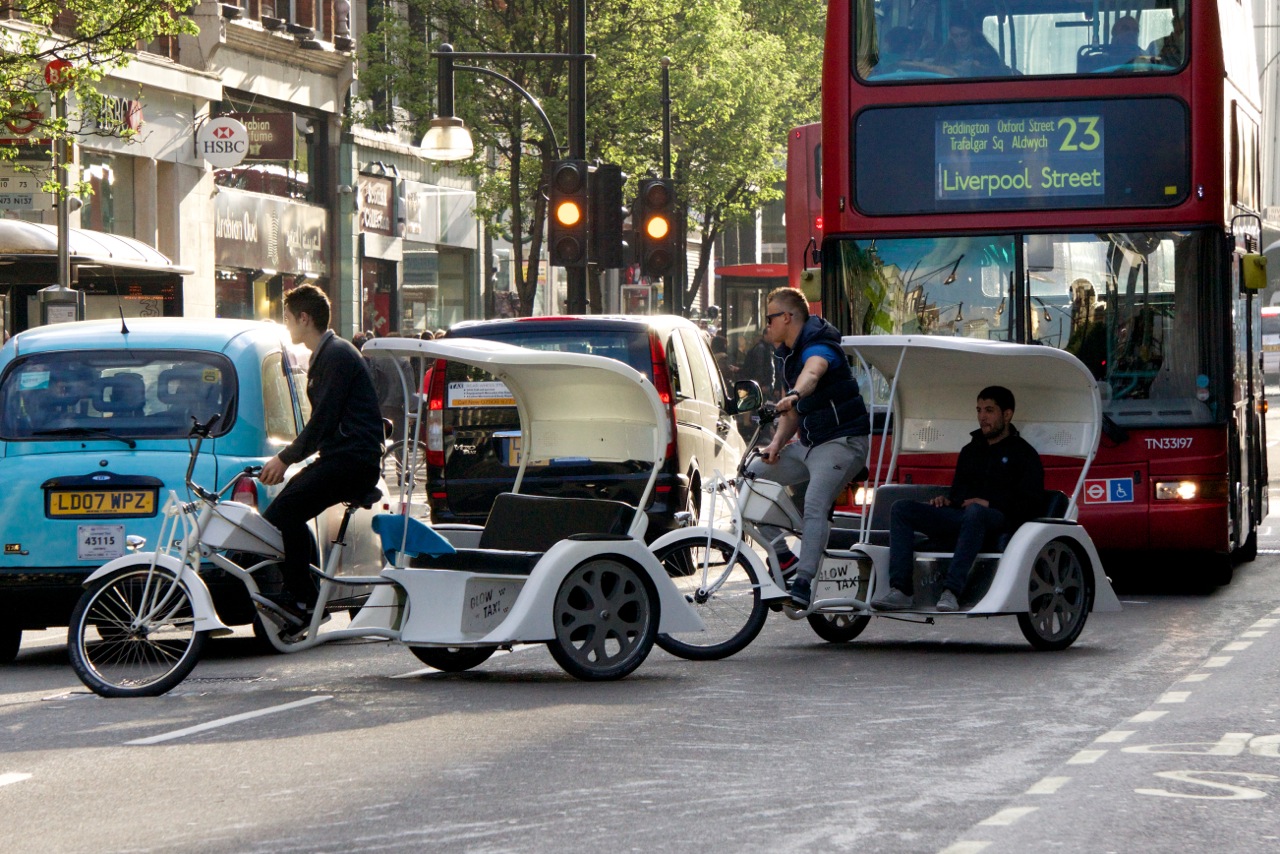
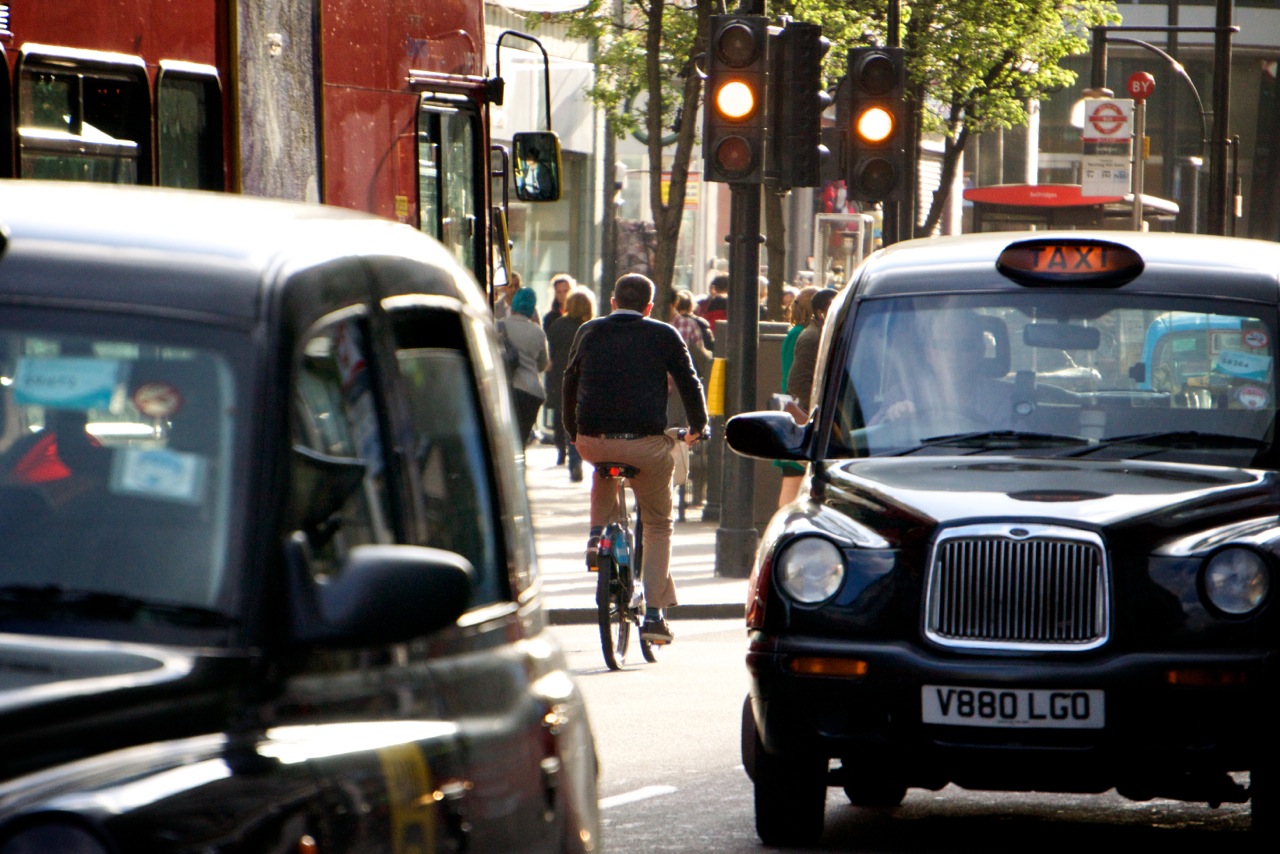
I am in London this week. There's lots of people on bicycles. It's impressive compared to Perth. Considering the amount of traffic and lack of space, their riding is almost heroic. This is Oxford Street on Monday afternoon.


Monday, 31 March 2014

Parking, pedestrians and government borders

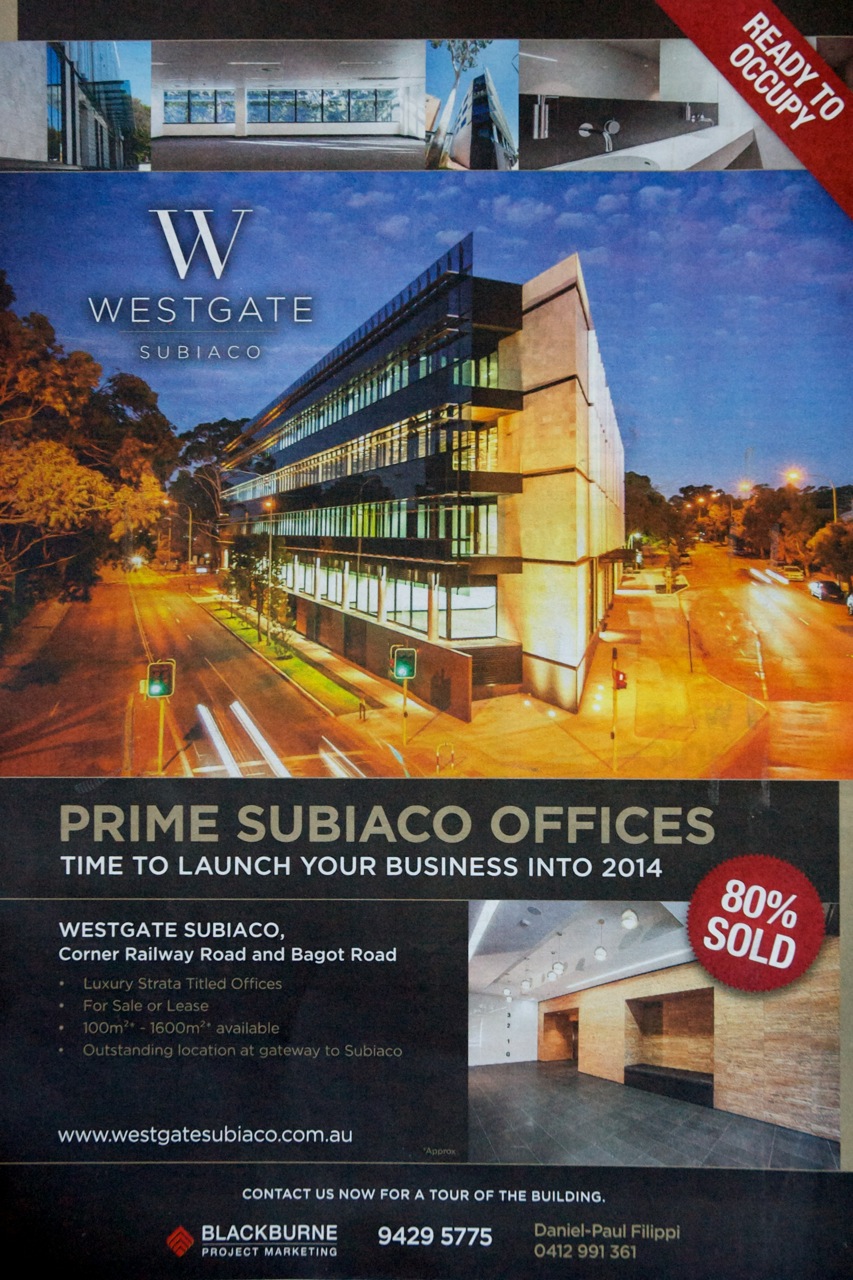
Here is a recent press advertisement for a new office building in Subiaco. The developers and photographer have found the best angle for the building to make it look good and help sell the office space. That camera position is about ten metres off the ground, at the second floor level. None us will ever see the building from that angle unless we hire a cherry picker and stand in the bucket high above the middle of the road.


This is how it appears for pedestrians at eye level. Not so good. The Railway Parade side of the building has eighty metres of blank wall punctuated with metal vents for the car park behind.


If you get back far enough, it looks OK, but for a person walking it offers nothing of interest. There is also no awning to provide any weather protection. An artist impression below, which must have been used during the pre-construction approval stages, shows a hedge on this side of the building. There is now no room for a hedge.


It is disappointing that the City of Subiaco has allowed such a bleak addition to the street scape. Imagine if every building was like this: it would be like walking in a concrete trench.

There are 133 cars bays in this building. 

+

The photographs show what 133 cars look like on the road. The City of Subiaco's outdated planning rules stipulate this is the minimum number that must park in the building. One car for every 40 square metres of office space.

It seems the City of Subiaco also have limited controls in place for how the parking is arranged. If the developers of Westgate had been required to put the parking below ground-level the street-level conditions for pedestrians could have been greatly improved. There is no basement in this building: there is a ground-level off Bagot Road, and another lower ground-level off Railway Road.

This building is 350 metres from the Daglish train station. The number 27 bus stops at the front door and the PSP (bike path) is only 50 metres away. This building has better transport connections than most of the office accommodation in St Georges Terrace, the heart of Perth's central business district.


Westgate in the City of Perth
If the Westgate building was constructed just two kilometres to the east, it would be out of the City of Subiaco and into the City of Perth's local government territory. The City of Perth have a completely different attitude to parking and the effect vehicle movements can have on a community. They stipulate  the maximum amount of parking allowable, not minimums. The calculations for car bays are done on land area and not lettable floor space. And they are much less. I am happy to be corrected, but my interpretation of the CoP parking policy gives a result of just 16 car bays if the Westgate building was over the border. 


That is a big difference:
  • 117 less cars in the lower levels of the building. Less blank walls and fewer vents. The architects could do something interesting with the ground floor. 
  • There would be over 230 less vehicle movements across the footpaths each day.
  • Out on the street, there would be a lot more people walking, using public transport and riding bicycles.

Westgate in the Town of Cambridge
Another comparison, which will make you despair if you care about walking. If Westgate was about one kilometre to the north of Subiaco, across the other border into the local government area called the Town of Cambridge, the number of car parking bays required in the same building would be 180. One car space for every 30 square metres of lettable office space.


Developers, if interested, have the ability to plea for a reduction in these numbers but with such a high starting position the negotiations may only give a reduction to levels that are still considered excessive in other local government areas.

For example, the developers of this mixed-use building under construction at 3 Loftus Street West Leederville managed to have the parking requirement reduced from 227 car bays to 129 (ToC council minutes PDF ).


Time to change the planning polices
There are parts of the Town of Cambridge, such as West Leederville, that are just two kilometres from the heart of Perth city. Subiaco is a similar distance. To have such dramatically different planning rules from the City of Perth makes no sense. These inner urban areas are really part of the city. These areas should be setting maximum parking requirements for buildings, not minimum.

Parts of the City of Subiaco look like this:


And there are parts of the City of Perth that look like this:


Trying to squeeze a lot of cars into buildings will continue to compromise the design and street scape in ways that are detrimental to pedestrians. We do not have to keep doing it.

If the The Shard was in the City of Subiaco instead of London? With its 110,000 square metres of floorspace it would be required to have a minimum of 2750 car bays.  It has just 47.